Randolph-Macon College formally inaugurated St. Bonaventure alumnus Dr. Michael E. Hill as its 16th president Friday, April 24, welcoming national voices, campus leaders, alumni and students to mark a defining moment in college history — and to help articulate a bold, forward-looking vision rooted in its enduring mission.
ASHLAND, VA — Randolph-Macon College formally inaugurated St. Bonaventure alumnus Dr. Michael E. Hill as its 16th president Friday, April 24, welcoming national voices, campus leaders, alumni and students to mark a defining moment in college history — and to help articulate a bold, forward-looking vision rooted in its enduring mission.
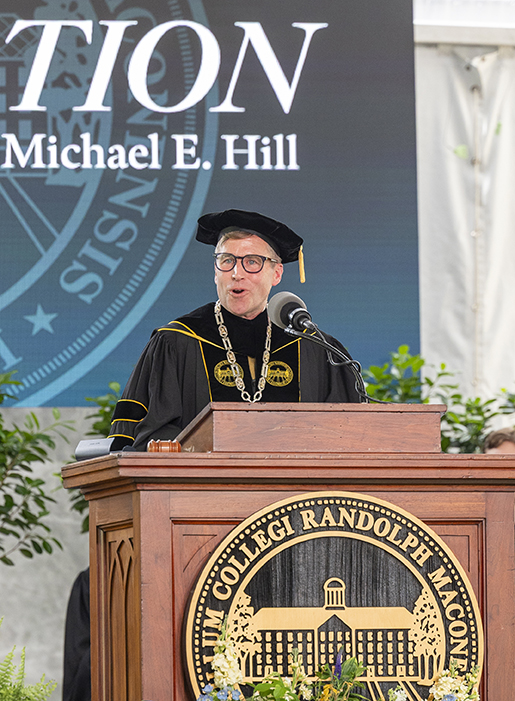
Hill earned a bachelor’s degree in Journalism & Mass Communications from St. Bonaventure in 1996. A former employee (1997-2002), Hill served on the SBU Board of Trustees from 2013-2022.
The inauguration ceremony and surrounding events highlighted Randolph-Macon’s momentum as an institution on the rise, as well as its renewed commitment to its mission of developing “mind and character” in every student — a principle that has guided the college for nearly two centuries.
In his inaugural address, Hill outlined a vision that bridges tradition and transformation: a liberal arts education that is both deeply human and decisively future-focused in an era when intelligence is increasingly artificial.
“Higher education ... exists to build minds capable of reason and characters capable of responsibility. It exists to prepare students not only for employment, but for citizenship, leadership, and moral agency in a complex world,” Hill told the assembled. “At a time when the future of work is at best hazy, the ability to adapt to uncertainty is priceless.”
A Vision Grounded in Tradition
Central to Hill’s vision is a focus on strengthening RMC’s dual-focused mission with more visible emphasis on its latter half — character. This work includes new initiatives that respond to the evolving landscape of higher education and society. Among those priorities:
- The RMC Pluralism Project, a recently announced initiative designed to foster meaningful dialogue across differences, equipping students to lead in an increasingly complex and interconnected world.
- A renewed investment in the humanities and the arts, positioning them as essential — not ancillary — to a modern education. These efforts will emphasize innovative teaching, interdisciplinary collaboration, and clear pathways from intellectual exploration to meaningful careers.
- A future-focused academic approach, one that prepares students to thrive in a world shaped by artificial intelligence and rapid technological change, while doubling down on the distinctly human capacities — problem solving, ethical reasoning, teamwork, creativity, and communication — that define the Randolph-Macon experience.
“These foundational skills that come from a liberal arts base do not stand in opposition to innovation or professional preparation,” Hill said. “They give both their moral compass. They ensure that progress is guided by wisdom, not merely speed; by judgment, not merely capacity.”
A Community Milestone
The inauguration served not only as a formal investiture for Hill (who has been on the job since August 1), but as a celebration of the entire Randolph-Macon community. Faculty, staff, students, alumni and trustees were joined by delegates from more than 40 colleges and universities across the country, along with distinguished speakers who contributed to Friday’s event and conversations throughout the week. Highlighted guests included Dr. Eboo Patel, founder of Interfaith America, celebrated poet and author Kwame Alexander, Broadway star Tiffany Mann, and two of the college’s living former presidents, Robert R. Lindgren (2006-2025) and Roger Martin (1997-2006).
Momentum and Opportunity
Hill’s inauguration comes at a time of strong institutional momentum for Randolph-Macon, with continued enrollment growth, expanded academic programs, athletic success, and a sharpened focus on student success and outcomes. As the College approaches its bicentennial in 2030, Hill emphasized that this moment represents an opportunity to build on that momentum with intention and clarity.
“It is time for RMC to seize this moment, to claim its rightful place as an exemplar of all that is right in higher education, and to resource itself not only for this bicentennial but for its many years to follow,” he said.