St. Bonaventure University
Artificial Intelligence at Bona's
In The News: Channel 2 WGRZ
“We’re a Franciscan institution, and we’re ensuring those values guide how we teach AI.” — Dr. David Hilmey, Provost and VP for Academic Affairs
Check out the news storySt. Bonaventure University is embracing artificial intelligence as a transformative tool for learning, research, and community engagement. Our approach centers on ethical innovation: advancing academic excellence while upholding the Franciscan values of compassion, reflection, and responsible stewardship.
Academic Innovation
Integrating AI Across the Curriculum
The university has approved new AI-focused courses in Computer Science and Philosophy and is collaborating with a consortium to develop AI Literacy and Applied AI programs as majors, minors, or concentrations. AI-related curriculum updates have been implemented across most academic disciplines, supported by $50,000 in funded AI curriculum projects this academic year. On the student-support side, we launched Ocelot, our AI chatbot known as “Ask Reilly” on my.sbu.edu, providing 24/7 assistance to enhance engagement, address routine inquiries, and streamline staff workloads. Additionally, a ChatGPT EDU pilot involving 300 students, faculty, and staff is now underway, offering access to one of the most secure and effective large language model platforms available.
Dr. Jeff Gingerich, University President
“To remain competitive and deliver an exceptional experience for students, faculty and staff, St. Bonaventure must not simply adopt AI tools — it must instill ethical use of them.”
Ethical Leadership and Governance
Franciscan Values in a Digital Age
St. Bonaventure continues to ground its use of artificial intelligence in strong ethical frameworks that prioritize privacy, data integrity, and responsible innovation. Through a Mission Integration lens, the university emphasizes using technology to serve others, advance the common good, and reflect our Franciscan values. Faculty across Philosophy, Theology, and Education are actively collaborating to examine the moral and societal impacts of AI, ensuring that innovation remains thoughtful and reflective.
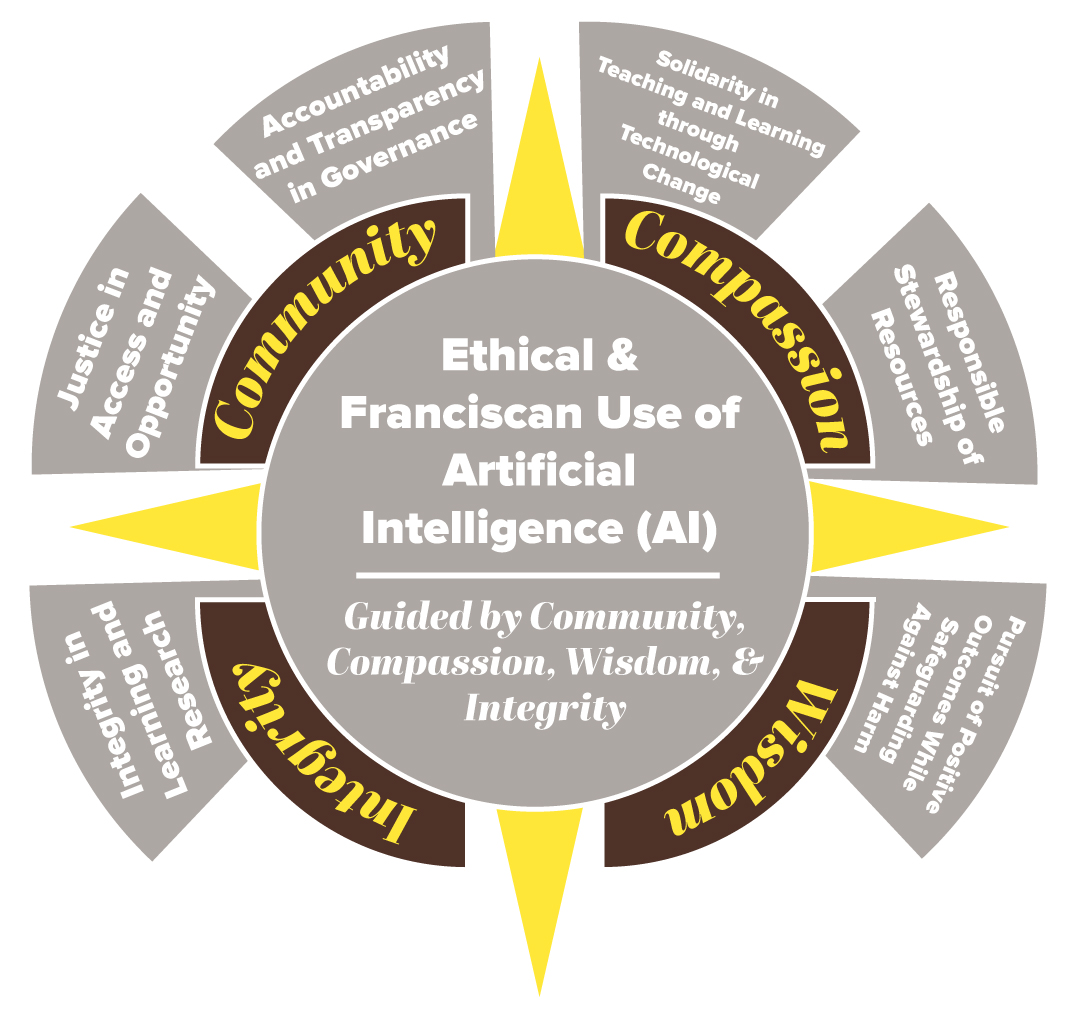
The Presidential Commission on Artificial Intelligence
Guiding the Future of AI at Bona's
In October 2025, President Jeff Gingerich established the Presidential Commission on Artificial Intelligence to provide strategic guidance on the academic, operational, and ethical integration of AI across the university. The commission was created to ensure that St. Bonaventure remains proactive, responsible, and mission-aligned as emerging technologies continue to transform higher education.
The commission’s work centers on several key focus areas: academic integration, governance and ethics, faculty and staff capacity, operational efficiency, and its ongoing advisory role to the President. Together, these priorities guide a comprehensive approach to AI that supports innovation while upholding the university’s values and long-term strategic goals.
Commission Membership:
- Dr. Mike Hoffman, co-chair, interim dean of the DePerro School of Health Professions, dean of the School of Graduate Studies, associate provost, and chief information officer
- Dr. Dave Hilmey, co-chair, provost and vice president for Academic Affairs
- Danny Bush, Senior Multimedia Producer
- Dr. Anne Foerst, professor of Computer Science
- Tim Geiger, director of Enterprise Services
- Fr. Stephen Mimnaugh, O.F.M., vice president for Mission Integration
- Tom Missel, chief communications officer
- Dawn Parisella, executive director of Employee Benefits and Campus Leave Administration
- Dr. Tracy Schrems, assistant professor of Education
- Dr. Stephen Setman, assistant professor of Philosophy
- Dr. Scott Simpson, professor of Chemistry
- Dr. Erin Sadlack, dean of Arts & Sciences
- Adriane Spencer, executive director of the Student Success Center
- Ann Tenglund, director of Friedsam Library and Faculty and Staff Resource Center
- Dr. Mark Wilson, professor of Finance

SBU panel explores AI, human dignity and the pursuit of truth
What does Pope Leo XIV have to say about artificial intelligence, and how can his insights help inform a St. Bonaventure education? These and other questions took center stage at a panel of students and professors on Wednesday, Oct. 21.
Co-hosted by the university’s Office for Mission Integration and the Department of Theology and Franciscan Studies, the panel was occasioned by the promulgation of Pope Leo’s encyclical Magnifica humanitas last May.
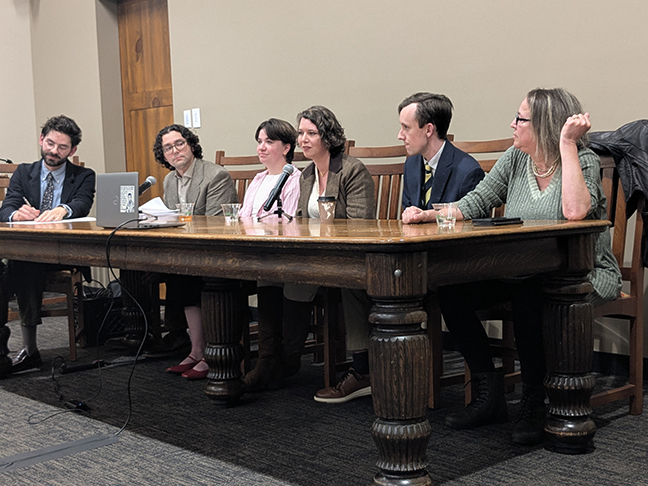
Fr. Stephen Mimnaugh, O.F.M., vice president for Mission Integration, noted that Pope Leo XIV sees the advent of artificial intelligence as a disruptive force akin to the Industrial Revolution. Like his namesake, Pope Leo XIII, who is credited with inaugurating modern Catholic social teaching with his encyclical Rerum Novarum, Pope Leo XIV seeks to draw on the riches of Catholic social teaching to safeguard human dignity in an age of rapid technological development.
Key themes emerging from the encyclical and explored throughout the panel discussion included the centrality of human connection and the need for human judgment and responsibility.
The panel featured Dr. Anne Foerst, professor of Computer Science and Cybersecurity; Dr. Stephen Setman, assistant professor of Philosophy; Dr. Taylor Ott, assistant professor of Theology and Franciscan Studies; Conor Amendola, ’26; and Alexis Serio, ’27. Moderating the panel was Dr. Andrew Belfield, assistant professor of Theology and Franciscan Studies.
Drawing on decades of research at the intersection of artificial intelligence and theology, Foerst highlighted the risks of anthropomorphizing chatbots and AI agents.
While people tend to project human traits onto these technologies — such as agency, responsibility and even emotional states — Foerst insisted that responsibility for these technologies must always rest with the human creators and users. Anthropomorphizing AI can obscure the nature of the technology itself, making it more difficult to recognize what responsible and ethical use requires.
Setman expanded on this point, noting that the responses generated by chatbots tend to be affirming to the point of sycophantic. This tendency, Setman argued, makes chatbots poor substitutes for human educators, who must be willing to challenge students’ conclusions, question their assumptions, and help them grow in their understanding of what is true and good. Education, in other words, is grounded in a relationship of trust and vulnerability between teacher and student.
The importance of human connection, a central concern of Magnifica humanitas, was a recurring theme throughout the panel discussion.
Ott, whose research focuses on Catholic social teaching and Catholic social thought, brought to the table Pope Leo’s insight that education is not merely an accumulation of facts and information; rather, it is a quest for truth.
This understanding of education as a search for truth is particularly relevant to SBU’s mission. Serio, whose student leadership with the Franciscan Center for Social Concern puts questions of Catholic-Franciscan mission at the front of her mind, noted that the search for truth is often deeply relational, as human encounters, both in and out of the classroom, are often the beginnings of wisdom.
Importantly, wisdom does not end at the edge of the classroom. A Bonaventure education must also prepare students to carry that wisdom with them into society, a point Amendola raised. Through his work as a student reporter for PolitiFact New York, Amendola has seen firsthand the rise of misinformation, accelerated by artificial intelligence, and the need for our university values of compassion, wisdom and integrity in the public square.
In a final speed round of questions, all panelists were asked to offer advice on navigating the use of AI in education. Faculty members emphasized the importance of intellectual humility, noting that education requires patience, a willingness to be wrong, and a broad pursuit of knowledge going beyond any one major or discipline. Students emphasized the importance of professors who give them opportunities to learn independently of AI, who show that they care about their students, and who challenge their students to do their best work.
After about an hour of discussion, the panel took questions from the audience. Faculty, staff, friars, and students asked a range of questions: from what panelists make of AI-generated homilies to whether a chatbot can serve as a moral exemplar to how professors can grapple with AI in the curriculum.
The panel discussion demonstrated that, regardless of AI’s effects on education, the human relationships at the heart of St. Bonaventure’s Catholic-Franciscan mission are more relevant than ever. Decisions to adopt AI in the work of higher education must be guided by the cultivation of compassion, wisdom and integrity that are at the heart of an SBU education: discovering what is true so that one might do what is good.
Contact Us
Dr. Michael Hoffman

Dr. David Hilmey