Oct 02, 2026
Choosing a college has always been a major decision. But as the cost and value of higher education face greater scrutiny, students and families are asking an increasingly important question: What will this education make possible?
For graduates of St. Bonaventure University, the latest outcomes offer a compelling answer.
Among members of the Class of 2025, 95.2% were employed, continuing their education, serving in the military or participating in service after graduation. And among employed graduates, 92.2% were working in fields related to their studies at St. Bonaventure.
Behind those numbers are graduates beginning careers across industries, pursuing advanced degrees, and answering calls to service. Their paths are different, but they share a foundation that prepared them to take the next step.
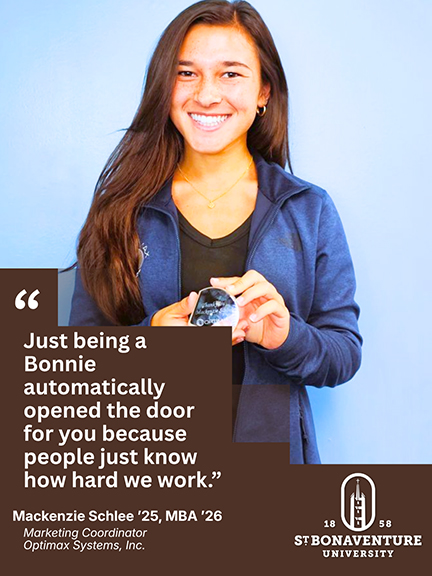
For Mackenzie Schlee, ’25, MBA ’26, the transition from college to career began before she ever crossed the commencement stage.
Today, Schlee is a marketing coordinator at Optimax, a precision optics company, where she manages digital marketing and helps coordinate trade shows around the world, including events in Germany and Tokyo. She first joined the company as an intern and transitioned into a full-time role after completing her MBA.
Schlee credits the hands-on nature of her Bonaventure education with helping prepare her for that transition. Her coursework went beyond textbooks, giving her opportunities to build websites, develop products and services, and create complete marketing campaigns and budgets.
“I think Bonaventure does a really great job at giving hands-on experience,” Schlee said. “We had so many projects that worked with real companies or even clubs on campus. It really gave me a better understanding of the real world and how companies work and run.”
Her preparation extended beyond the classroom. Schlee’s adviser, Dr. Dharti Trivedi, assistant professor of Marketing, helped her navigate her academic path and connected her with her first internship at Mettler Toledo, helping her build the experience that would position her for future internships and, eventually, her current career.
Schlee’s experience reflects a broader pattern among recent Bonaventure graduates whose paths stretch across healthcare, education, professional services, finance, insurance, real estate, consulting, information, government and more.
Those outcomes don’t begin at commencement.
Preparing for What Comes Next
Career preparation at St. Bonaventure begins long before graduation through internships, research, clinical work, campus organizations and hands-on learning. Faculty who know their students’ goals help connect them with opportunities, while the Career and Professional Readiness Center provides support with career exploration, résumés, interviewing, internships, jobs and professional connections.
Those connections extend beyond campus through a network of Bonnies working across industries and around the country.
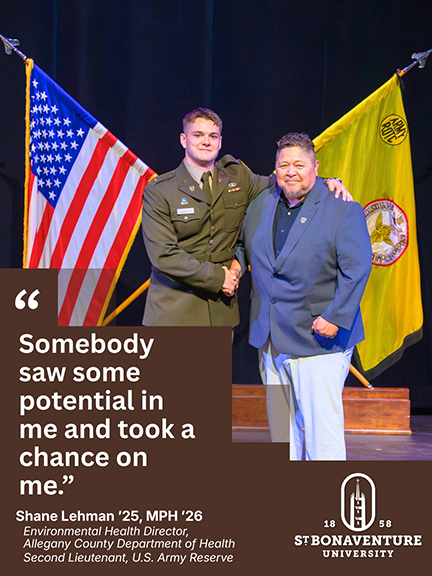
For Shane Lehman, ’25, MPH ’26, those relationships changed the trajectory of his education and ultimately his career.
Lehman came to St. Bonaventure through a connection with Frank Morales and the university’s military-aligned student community. Already enlisted in the Army Reserve, Lehman hadn’t initially planned on attending college. Morales, director of the Military Aligned Students Program, helped him secure a four-year ROTC scholarship and provided a community when military training prevented him from participating in many traditional activities for incoming students.
That support continued as Lehman pursued degrees in Public Health while participating in ROTC. He worked closely with faculty in the DePerro School of Health Professions, helped build the B.O.N.A.S. Challenge wellness program, and gained experience through student leadership, a graduate assistantship, and teaching opportunities.
Those experiences helped prepare Lehman for two careers. Today, he serves as an environmental health director for Allegany County while also serving as an intelligence officer in the Army Reserve. He has remained connected to Bonaventure as an adjunct instructor in Public Health, bringing his professional experience back into the classroom.
His path wasn’t always straightforward. Lehman described struggling academically during his first semester, but faculty saw his potential and gave him opportunities to grow.
“Somebody saw some potential in me and took a chance on me,” Lehman said. “You’re not going to get that at a bigger school. You’re not going to get that at most places.”
Those relationships and experiences helped turn a student who wasn’t certain that college was part of his future into a graduate with an advanced degree, a civilian career, military leadership responsibilities, and a place in the classroom educating the next generation.
Preparing Graduates for Careers, Not Just Jobs
The return on a college education shouldn’t be measured only by how quickly a graduate receives a first job offer.
Careers change. Industries evolve. New technologies reshape professions. The lasting value of an education is also found in whether graduates leave prepared to think critically, communicate, solve problems, adapt and continue learning.
The university’s approach continues to receive outside recognition, including a No. 10 ranking for Best Undergraduate Teaching among Regional Universities in the North in the 2027 U.S. News & World Report rankings.
But perhaps the strongest evidence comes from the graduates themselves.
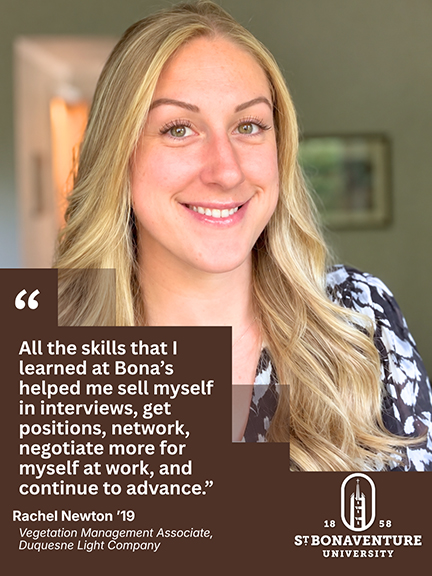
For Rachel Newton, ’19, that preparation has meant having the skills and confidence to follow a career path she could not have predicted when she arrived at St. Bonaventure.
After graduating with a degree in Environmental Studies and a minor in Management, Newton began her career in utility forestry at Duquesne Light before spending nearly four years in environmental consulting, helping major retailers manage hazardous waste and regulatory compliance. She eventually returned to Duquesne Light, where she now works as a vegetation management associate, assessing trees near power lines, identifying potential hazards, and overseeing contractors in the field.
It is a career she didn’t know existed when she was a college student.
Newton entered Bonaventure as a Biology major before becoming one of the early students in the university’s then-new Environmental Studies program. She originally imagined a career in environmental or sustainability consulting, but her interests eventually evolved toward arboriculture and utility forestry.
What prepared her to navigate those changes, she said, wasn’t only what she learned within her major. Through Bonaventure’s Competitive Edge program offered by the CPRC, she developed interviewing, networking and workplace skills. Experiences in her management minor strengthened her ability to communicate and advocate for herself professionally.
“I think all the skills that I learned at Bona’s helped me sell myself in interviews and get positions and network and negotiate more for myself at work and continue to advance,” Newton said.
For students who don’t yet know exactly where their education will take them, Newton’s advice is simple: “Don’t panic.”
“Try stuff out,” she said. “You don’t have to have it figured out.”
Newton’s career hasn’t followed the path she expected when she graduated. She’s changed roles, discovered a field she didn’t know existed, and figured out along the way what she wants from her career.
That’s part of what the Class of 2025 outcomes represent. A first job matters, but so do the experiences, relationships and skills that prepare graduates for whatever comes after it.
Because the value of a degree isn’t simply in earning it.
It’s where it can take you.