St. Bonaventure University
News Releases
Small Atoms. Big Ideas.
Scott Simpson’s groundbreaking hydrogen research is earning international attention while showing Bona’s students just how far chemistry can take them
Story by Susan Anderson | Photos by Faith Gworek
“Electrons are fuzzy and really smeared out.”
That’s how St. Bonaventure Chemistry Professor Dr. Scott Simpson describes one of the fundamental challenges of his research: using computers and mathematics to predict what happens during chemical reactions.
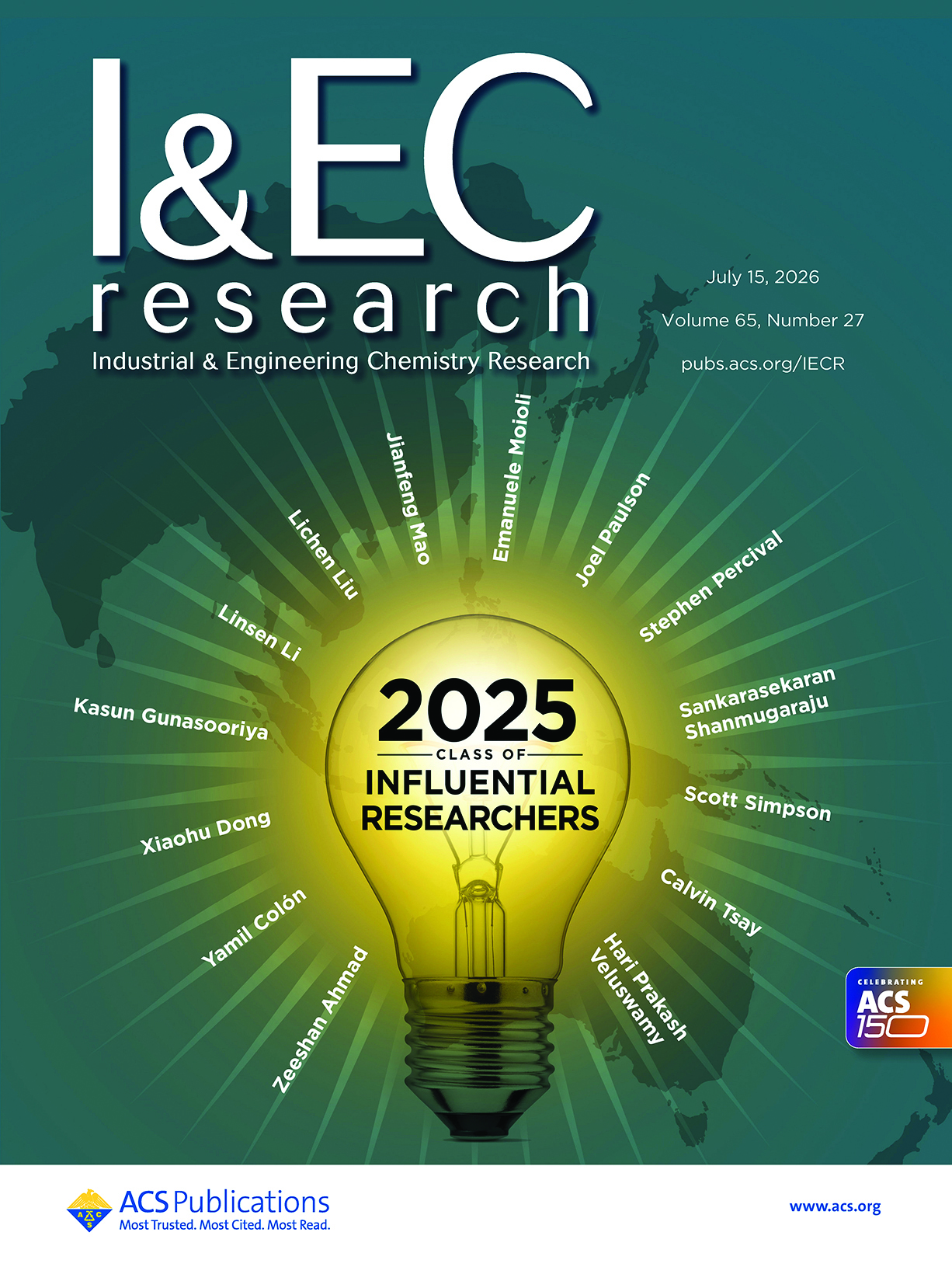
That approach, known as density functional theory, is at the heart of the research that earned him international recognition. The American Chemical Society has named Simpson to the 2025 Class of Influential Researchers through its scholarly journal
Industrial & Engineering Chemistry Research (at right), making him one of just 16 early-career scientists worldwide recognized for the quality of their work and significant contributions to chemistry and chemical engineering.
The award recognizes Simpson’s research into hydrogen as a viable alternative energy source. One focus of his work is understanding how hydrogen molecules break apart on surfaces, which is a critical step in making hydrogen practical for energy applications. His research explores how mixtures of metals, such as copper and palladium, can be used to trigger that reaction.
“This work is all about understanding why copper does not split molecular hydrogen into atomistic hydrogen — but toss on a bit of palladium and it suddenly can!” Simpson said. “This has applications in hydrogen as an alternative energy source compared to fossil fuels, which are finite.”
Chemists call the process catalysis, he said.
“It’s about making chemical reactions that don’t want to happen, happen,” Simpson explained. “So, what you’re doing is driving the cost down for the consumer because chemical reactions that take a lot of energy or time cost a lot of money.”
 Simpson’s fellow honorees represent leading global research institutions, including Imperial College London, the University of Wisconsin-Madison, the University of Texas and Sandia National Laboratories.
While the international honor recognizes his contributions to hydrogen research, Simpson says his greatest motivation remains helping students see how chemistry can solve real-world problems.
“I’m very happy about the award,” he said. “A lot of people look at undergraduate institutions and think research is playtime or not real. But it is real — and this shows it.”
Building an Undergraduate Research Culture at Bona’s
Simpson said it takes a place like Bona’s — with the right mix of students, faculty members, alumni and resources — to make an award like this possible. He has spent the past decade helping create that environment by obtaining multiple research grants from the National Science Foundation, Dreyfus Foundation and the American Chemical Society’s Petroleum Research Fund.
 Thanks to those competitive grants and the generosity of donors, the department’s instrumentation suite now includes more than a dozen pieces of research and teaching equipment valued at more than $2 million.
Simpson also built a 47-node high-performance computing (HPC) cluster that supports not only computational chemistry research and student projects but also other research happening at the university.
He credits his mother, Bona grad Debra Simpson, ’81, ’87, an elementary school teacher, with instilling the importance of strong fundamentals. He carries that emphasis into his own teaching and has integrated fundamentals and computational methods into an educational style for undergraduates.
He said his goal as a professor is to “foster lifelong learning and real-world problem-solving skills” in his students. He is committed to helping them visualize what can be done in chemistry, both academically and in the job market.
That hands-on approach is one of the qualities that most impresses Dr. Erin Sadlack, dean of the School of Arts & Sciences.
“Our undergraduates get Dr. Simpson’s attention from day one,” Sadlack said.
Simpson mentors several undergraduate researchers each year. They work alongside him, conduct publishable research, present at conferences and even co-author papers. Such opportunities are more commonly associated with much larger universities and are often reserved for graduate students, Sadlack noted.
“Being able to work with someone of Dr. Simpson’s caliber is exciting for everyone,” she said. “This recognition reflects the respect he has earned among fellow chemists, and our students have the extraordinary opportunity to learn from — and contribute to — the work of a researcher whose discoveries are advancing the field.”
From Students to Colleagues
 Jacob Smeraldo, this year’s Maydonovitch Research Fellow and senior Chemistry and Biochemistry double major from Jamestown, New York, says his experiences with Simpson have allowed him to see “all the hats he wears, as an administrator serving on committees, a researcher, a teacher and a mentor.”
Smeraldo serves alongside Simpson on the university’s Presidential Commission on Artificial Intelligence. Their conversations often turn to the changing demands of their field and “how any good chemist will need background in AI, computation and lab work.”
“We’re always sending papers back and forth and just talking about what is happening in chemistry,” Smeraldo said.
“Dr. Simpson is always there to help you with anything, whether for class, research or a personal reason,” he said. “His attitude toward teaching and his students is always positive.”
Simpson’s relationships with students often evolve from teacher to mentor to colleague.
James Brown, ’18, who majored in Chemistry, went on to earn a master’s degree and doctorate and later taught at the University of the Incarnate Word. As a professor himself, Brown drew upon the example Simpson had set.
“Dr. Simpson was a good role model in how to be approachable as a professor, how to build connections with the students and inspire them to want to learn and enjoy the subject,” Brown said.
Today, Brown works for Dirigo Sea Farm, where he helps develop sustainable materials using seaweed as a renewable feedstock. He and Simpson keep in touch, discussing computational chemistry, including “limitations in modeling that you can recognize, appreciate and work around,” as well as possibilities for future research projects.
A Global Reach
Simpson also collaborates with colleagues across the United States and Europe, with particularly strong ties to the University at Buffalo, where he mentors graduate students, many of them St. Bonaventure alumni.
He regularly presents his research to scientific and public audiences nationally and internationally, including at American Chemical Society national meetings, the International Chemical Congress of Pacific Basin Societies, Aalto University in Finland, and the European Symposium on Chemical Bonding in Amsterdam.
In September, Simpson returned to the European Symposium on Chemical Bonding as an invited speaker, joining international researchers in chemical bonding, quantum chemistry and electronic-structure theory.
He is professor of Chemistry, chair of the Chemistry Department and director of the Honors Program. Across those roles, his focus continually returns to helping young researchers be ready for anything the future holds.
“I want to show that chemistry is not just an academic thing. There are a lot of jobs,” Simpson said. “I want them to see what’s possible through chemistry.”