Apr 22, 2026
Dr. Scott Simpson, professor of Chemistry and chair of the Department of Chemistry, is a co-author of a newly accepted paper in the Journal of Chemical Information and Modeling that could help strengthen future research on PFAS, often called “forever chemicals.”
The study created a large open-access database and compared 47 computer-based chemistry methods to identify which most reliably predict important PFAS properties, such as bond strength, polarity, electron affinity and ionization potential. PFAS are widely used, extremely persistent in the environment, difficult to break down and have been linked to a range of health concerns. By giving scientists a clearer way to select trustworthy modeling methods, the research can improve how PFAS are studied and support future work on contamination, risk and cleanup.
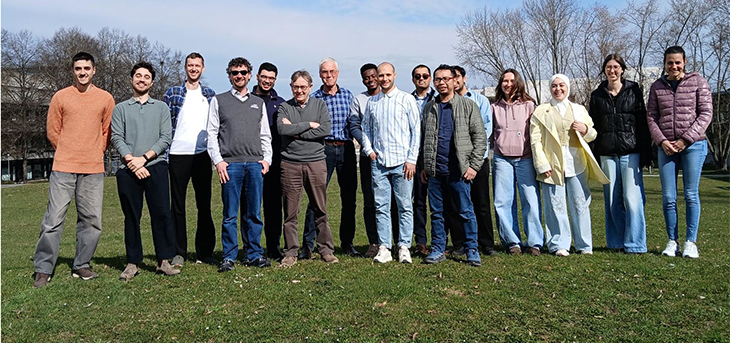
In addition, Simpson attended the COSMO-RS Block Lecture in Regensburg, Germany, March 23-27, to learn more about the COSMO-RS computational method and its potential applications to his PFAS teaching and research at St. Bonaventure. COSMO (Conductor-like Screening Model) is a method used to calculate the electrostatic interaction of a molecule with a surrounding solvent by treating the solvent as a conductor and generating surface charges. COSMO-RS (Conductor-like Screening Model for Realistic Solvation), developed by Dr. Andreas Klamt, combines quantum chemical calculations (from COSMO) with statistical thermodynamics to predict properties such as solubility, partition coefficients and vapor pressure.
The lecture was taught by Klamt.
The training complements Simpson’s recent work on how PFAS acidity and hydrophilicity/lipophilicity affect environmental mobility and will also inform his mentoring of student researchers.