From the Director’s Desk: Spotlight & Solutions
Whether you’re upskilling for leadership, pivoting into security from IT or adjacent fields, or moving directly from a bachelor’s to a cybersecurity master’s, this guide clarifies when a master’s in cybersecurity makes sense, when a certification is enough—and when a blend is the fastest path.
As SBU’s Director of Cybersecurity Programs (B.S. & M.S.), I’m often asked what sets our apart from
online master’s in cybersecurity certifications when it comes to advancing a career. The difference is significant. Read on to learn more.
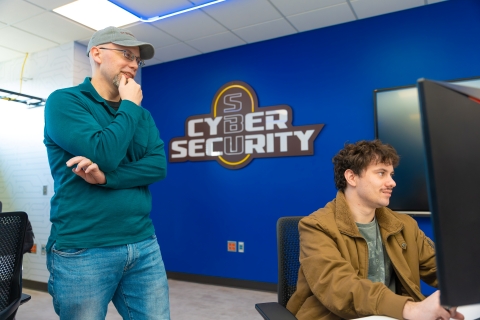
Master’s Degree vs. Certifications: What actually changes your trajectory?
In today’s talent‑hungry market, prospective cybersecurity professionals often face a simple question: Do I go the “certification” route or invest in a master’s degree? The answer depends on what you want from your education and the career path you envision.
1. Depth vs. Breadth
Master’s Degree
- Provides a comprehensive curriculum that covers technical foundations, risk management, policy, architecture, and emerging threats. At SBU, we expose our students to a wide range of cybersecurity disciplines, laying a solid foundation from which they can deepen and refine their expertise.
- SBU’s program emphasizes real‑world custom labs where students tackle scenarios that mirror enterprise environments, allowing theory to translate directly into practice.
- Mentorship is central: Our professors guide you through iterative problem‑solving rather than rewarding a single “right” answer. This approach mirrors how security teams operate in the field, where learning from mistakes and iteration is essential.
- We focus on problem-solving and critical thinking skills that are applicable to any role in cybersecurity.
Cybersecurity Certifications
- Focuses on specific skill sets or knowledge domains, great for validating expertise quickly (e.g., CISSP, CEH).
- Cybersecurity certifications are often shorter to obtain, typically a few weeks of study plus an exam. Most certifications require retaking the test every couple of years and/or completing continuing education credits to retain the certification.
- Ideal for professionals who already have experience and need to demonstrate competence in a particular niche.
2. Cyber Security Career Impact & Salary Outlook
| Outcome | Master’s Degree | Certification |
| Salary Potential | Median salaries for MS graduates range from $120k–$180k, especially in leadership or specialized roles (detection engineer, incident response, cloud security, digital forensics, penetration testing, risk management, security architect). | Certified professionals (CISSP, CEH, etc.) often earn $10k– $25k more than non‑certified peers.
|
| Career Advancement | Equips you for managerial, strategic, and CISO positions that demand a holistic understanding of security and business alignment. | Enhances credibility in specific technical tracks (e.g., penetration testing). |
| Job Flexibility | A master’s degree opens doors across industries: finance, healthcare, defense, academia. | Certifications may be required for certain roles but can limit you to specialized positions if not paired with broader experience. |
3. Learning Experience
SBU’s MS in Cybersecurity program is built around practical content and labs that mimic enterprise challenges; network hardening, incident response simulations, and secure architecture design, making the transition from classroom to workplace seamless. The mentorship model ensures graduates of our cybersecurity master’s program are coached through iterative problem‑solving rather than rote memorization and scripted outcomes.
4. Bottom Line
If you’re starting out or seeking a cybersecurity career change, a master’s degree offers depth, real‑world labs, and mentorship that can accelerate progression into senior roles. If you already possess industry experience and need to validate niche expertise quickly, professional certification is the efficient path. Also note that this does not have to be a binary choice. Pursuing both is a path many often take.
In either case, combining formal education with hands‑on practice — whether through lab work or on‑the‑job projects, yields the best return on investment in today’s cyber security landscape.
If you’d like to discover more about
SBU’s online master’s in cybersecurity program and the opportunities it offers, explore how our 7-week courses keep you moving at a fast, flexible pace—and how our no GRE cybersecurity admission pathway makes it easier to get started. Feel free to
send me an email, connect with me on
LinkedIn, or give me a call at (716) 375-2044.
Brian Kellogg
Program Director for the B.S. and M.S. in Cybersecurity