St. Bonaventure University
Artificial Intelligence at Bona's
In The News: Channel 2 WGRZ
“We’re a Franciscan institution, and we’re ensuring those values guide how we teach AI.” — Dr. David Hilmey, Provost and VP for Academic Affairs
Check out the news storySt. Bonaventure University is embracing artificial intelligence as a transformative tool for learning, research, and community engagement. Our approach centers on ethical innovation: advancing academic excellence while upholding the Franciscan values of compassion, reflection, and responsible stewardship.
Academic Innovation
Integrating AI Across the Curriculum
The university has approved new AI-focused courses in Computer Science and Philosophy and is collaborating with a consortium to develop AI Literacy and Applied AI programs as majors, minors, or concentrations. AI-related curriculum updates have been implemented across most academic disciplines, supported by $50,000 in funded AI curriculum projects this academic year. On the student-support side, we launched Ocelot, our AI chatbot known as “Ask Reilly” on my.sbu.edu, providing 24/7 assistance to enhance engagement, address routine inquiries, and streamline staff workloads. Additionally, a ChatGPT EDU pilot involving 300 students, faculty, and staff is now underway, offering access to one of the most secure and effective large language model platforms available.
Dr. Jeff Gingerich, University President
“To remain competitive and deliver an exceptional experience for students, faculty and staff, St. Bonaventure must not simply adopt AI tools — it must instill ethical use of them.”
Ethical Leadership and Governance
Franciscan Values in a Digital Age
St. Bonaventure continues to ground its use of artificial intelligence in strong ethical frameworks that prioritize privacy, data integrity, and responsible innovation. Through a Mission Integration lens, the university emphasizes using technology to serve others, advance the common good, and reflect our Franciscan values. Faculty across Philosophy, Theology, and Education are actively collaborating to examine the moral and societal impacts of AI, ensuring that innovation remains thoughtful and reflective.
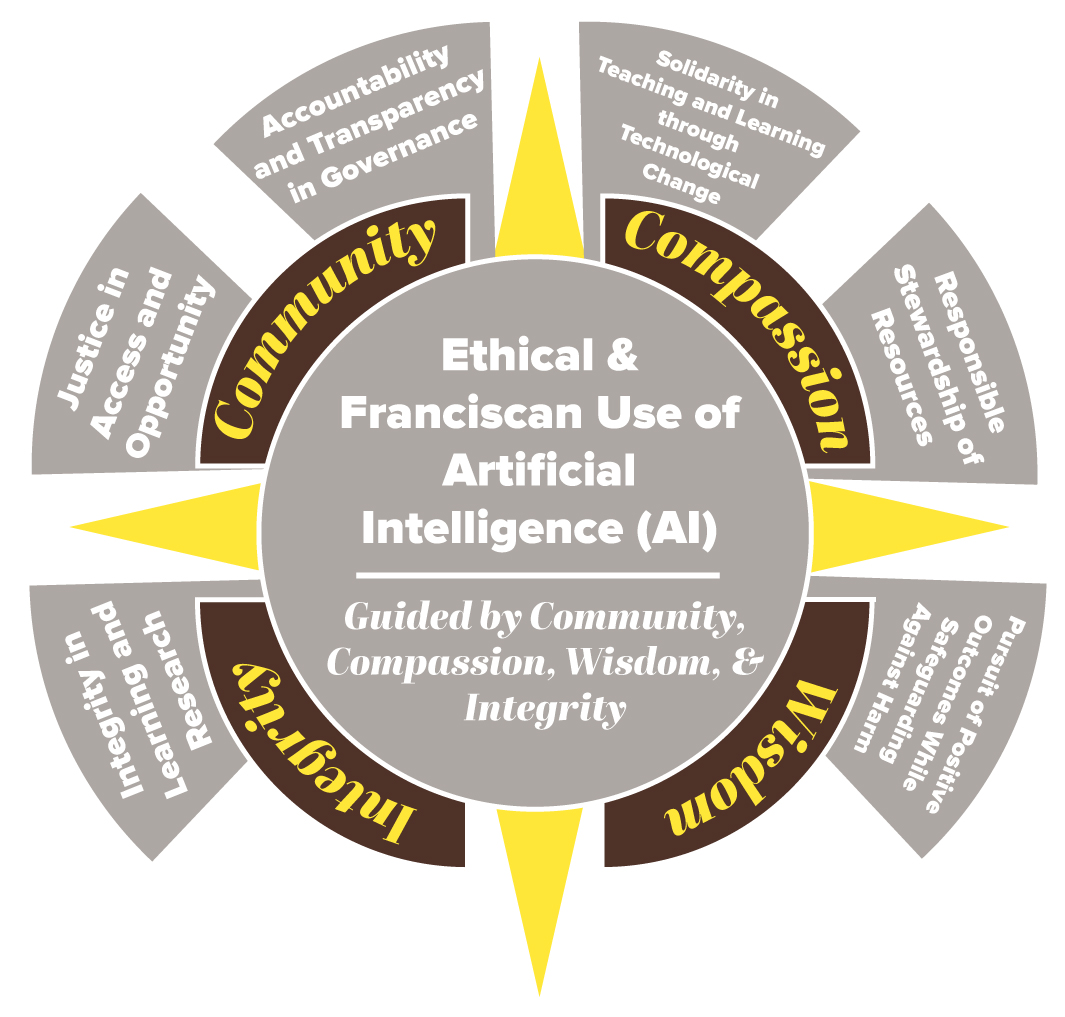
The Presidential Commission on Artificial Intelligence
Guiding the Future of AI at Bona's
In October 2025, President Jeff Gingerich established the Presidential Commission on Artificial Intelligence to provide strategic guidance on the academic, operational, and ethical integration of AI across the university. The commission was created to ensure that St. Bonaventure remains proactive, responsible, and mission-aligned as emerging technologies continue to transform higher education.
The commission’s work centers on several key focus areas: academic integration, governance and ethics, faculty and staff capacity, operational efficiency, and its ongoing advisory role to the President. Together, these priorities guide a comprehensive approach to AI that supports innovation while upholding the university’s values and long-term strategic goals.
Commission Membership:
- Dr. Mike Hoffman, co-chair, dean of the School of Graduate Studies, associate provost, and chief information officer
- Dr. Dave Hilmey, co-chair, provost and vice president for Academic Affairs
- Danny Bush, Senior Multimedia Producer
- Dr. Anne Foerst, professor of Computer Science
- Tim Geiger, director of Enterprise Services
- Fr. Stephen Mimnaugh, O.F.M., vice president for Mission Integration
- Tom Missel, chief communications officer
- Dawn Parisella, executive director of Employee Benefits and Campus Leave Administration
- Dr. Tracy Schrems, assistant professor of Education
- Dr. Stephen Setman, assistant professor of Philosophy
- Dr. Scott Simpson, professor of Chemistry
- Dr. Erin Sadlack, dean of Arts & Sciences
- Adriane Spencer, executive director of the Student Success Center
- Ann Tenglund, director of Friedsam Library and Faculty and Staff Resource Center
- Dr. Mark Wilson, professor of Finance

Video chronicles unique SBU class project tying AI to nutrition
Students and faculty from three academic schools at St. Bonaventure University came together for a unique academic collaboration that blended nutrition science, communication, philosophy and emerging technology.
The fall semester project culminated in a 15-minute documentary that chronicles their work at the intersection of artificial intelligence, food insecurity and healthcare.
The project united students in HS 309: Nutrition, taught by Dr. Jeffrey Allen, assistant professor and chair of Public Health and Health Sciences in the School of Health Professions, with students in JMC 343: Field Production, taught by Danny Bush, senior multimedia producer at the university and an adjunct faculty member in the Jandoli School of Communication.
Dr. Heather McDivitt, assistant professor of Philosophy from the School of Arts & Sciences, contributed as a guest lecturer and academic collaborator.
The students in HS 309 included those majoring in Health Science, Public Health, Nursing and Sport Studies.
Funded by a $3,000 Keenan Grant supporting innovative uses of artificial intelligence, the project challenged nutrition students to explore both the promise and limitations of AI in healthcare-related nutrition counseling.
Student groups were tasked with creating AI-generated, seven-day meal plans for lower-income families, each scenario including a family member living with a chronic disease or health condition.
In an experiential twist, each group had to follow another group’s AI-generated meal plan for a full week. Students documented their experiences navigating food access, cost, preparation and nutritional adequacy while relying on AI-informed guidance. Their reflections revealed both the efficiencies and shortcomings of AI tools when applied to real-world nutrition challenges.
“This project exposed students to the pitfalls and promise of AI use in healthcare-related nutrition counseling,” Allen said. “By actually living with these meal plans, students confronted the realities of food insecurity and the ethical responsibilities that come with using AI in health professions.”
While the nutrition students carried out the research and lived experience, Bush’s Field Production students documented the semester-long collaboration. One of two major projects for the 15-student JMC 343 class, the documentary captures classroom discussions, meal preparation, focus groups and the public screening of the finished film on Dec. 10.
“Danny’s students produced a 15-minute documentary about the semester, and it is beautifully done,” Allen said. “It really tells a story about how we at St. Bonaventure set ourselves apart.”
McDivitt’s involvement added a philosophical and ethical dimension to the project, expanding it into a three-school collaboration. She led discussions on the values people use when selecting and buying food, reviewed student papers, visited a student group during a shared breakfast and participated in focus groups and the public viewing of the documentary.
“It was a fabulous experience,” McDivitt said. “It was a terrific learning opportunity for the students and a great chance for me to work with colleagues outside of Arts and Sciences. Conversations about food, values and technology are essential as AI becomes more integrated into everyday decision-making.”
The project exemplifies St. Bonaventure’s Franciscan commitment to hands-on learning, interdisciplinary collaboration and ethical reflection.
By combining applied science, storytelling and philosophical inquiry, students gained a deeper understanding of how emerging technologies affect vulnerable populations and professional practice, Allen said.
______________
About the University: The nation’s first Franciscan university, St. Bonaventure is a community committed to transforming the lives of its students inside and outside the classroom, inspiring in them a commitment to academic excellence and lifelong civic engagement. Out of 167 regional universities in the North, St. Bonaventure was ranked #8 for value and #19 overall by U.S. News and World Report (2025).
Contact Us
Dr. Michael Hoffman

Dr. David Hilmey