St. Bonaventure University
Artificial Intelligence at Bona's
In The News: Channel 2 WGRZ
“We’re a Franciscan institution, and we’re ensuring those values guide how we teach AI.” — Dr. David Hilmey, Provost and VP for Academic Affairs
Check out the news storySt. Bonaventure University is embracing artificial intelligence as a transformative tool for learning, research, and community engagement. Our approach centers on ethical innovation: advancing academic excellence while upholding the Franciscan values of compassion, reflection, and responsible stewardship.
Academic Innovation
Integrating AI Across the Curriculum
The university has approved new AI-focused courses in Computer Science and Philosophy and is collaborating with a consortium to develop AI Literacy and Applied AI programs as majors, minors, or concentrations. AI-related curriculum updates have been implemented across most academic disciplines, supported by $50,000 in funded AI curriculum projects this academic year. On the student-support side, we launched Ocelot, our AI chatbot known as “Ask Reilly” on my.sbu.edu, providing 24/7 assistance to enhance engagement, address routine inquiries, and streamline staff workloads. Additionally, a ChatGPT EDU pilot involving 300 students, faculty, and staff is now underway, offering access to one of the most secure and effective large language model platforms available.
Dr. Jeff Gingerich, University President
“To remain competitive and deliver an exceptional experience for students, faculty and staff, St. Bonaventure must not simply adopt AI tools — it must instill ethical use of them.”
Ethical Leadership and Governance
Franciscan Values in a Digital Age
St. Bonaventure continues to ground its use of artificial intelligence in strong ethical frameworks that prioritize privacy, data integrity, and responsible innovation. Through a Mission Integration lens, the university emphasizes using technology to serve others, advance the common good, and reflect our Franciscan values. Faculty across Philosophy, Theology, and Education are actively collaborating to examine the moral and societal impacts of AI, ensuring that innovation remains thoughtful and reflective.
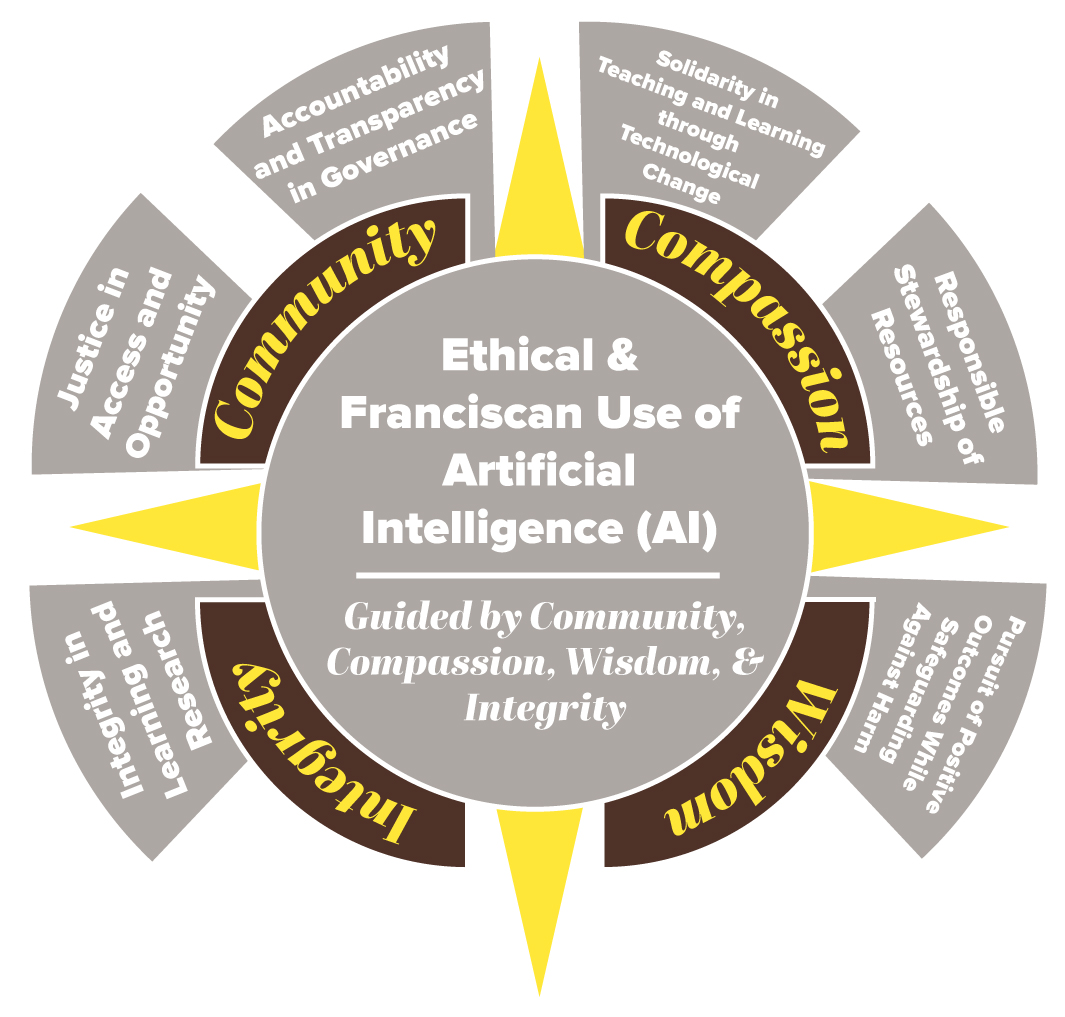
The Presidential Commission on Artificial Intelligence
Guiding the Future of AI at Bona's
In October 2025, President Jeff Gingerich established the Presidential Commission on Artificial Intelligence to provide strategic guidance on the academic, operational, and ethical integration of AI across the university. The commission was created to ensure that St. Bonaventure remains proactive, responsible, and mission-aligned as emerging technologies continue to transform higher education.
The commission’s work centers on several key focus areas: academic integration, governance and ethics, faculty and staff capacity, operational efficiency, and its ongoing advisory role to the President. Together, these priorities guide a comprehensive approach to AI that supports innovation while upholding the university’s values and long-term strategic goals.
Commission Membership:
- Dr. Mike Hoffman, co-chair, dean of the School of Graduate Studies, associate provost, and chief information officer
- Dr. Dave Hilmey, co-chair, provost and vice president for Academic Affairs
- Danny Bush, Senior Multimedia Producer
- Dr. Anne Foerst, professor of Computer Science
- Tim Geiger, director of Enterprise Services
- Fr. Stephen Mimnaugh, O.F.M., vice president for Mission Integration
- Tom Missel, chief communications officer
- Dawn Parisella, executive director of Employee Benefits and Campus Leave Administration
- Dr. Tracy Schrems, assistant professor of Education
- Dr. Stephen Setman, assistant professor of Philosophy
- Dr. Scott Simpson, professor of Chemistry
- Dr. Erin Sadlack, dean of Arts & Sciences
- Adriane Spencer, executive director of the Student Success Center
- Ann Tenglund, director of Friedsam Library and Faculty and Staff Resource Center
- Dr. Mark Wilson, professor of Finance

SBU senior wins AI video contest from Broadcast Education Association
St. Bonaventure University senior Tanner Pasi has won the Broadcast Education Association’s inaugural Gen AI Competition, an innovative challenge that tasked students with creating a 30-second video entirely through artificial intelligence tools — all within just 60 minutes.
Pasi, an English major from St. Marys, Pennsylvania, produced his winning entry using Sora 2, OpenAI’s advanced text-to-video generator.
“I was thrilled. I literally started shaking with excitement as I started processing the news,” Pasi said upon learning he had won the national competition.
The BEA challenge, open to colleges and universities across the country, required students to create a fully AI-generated video — including visuals, narration and effects — aligning with a themed prompt released by the organization.
The guidelines students had to use to create their AI prompt was that they had just witnessed the “greatest scene in the history of sports” at a world championship athletics event held in Moscow in 1980 (but not the boycotted 1980 Summer Olympics). They were allowed to interpret what “greatest” meant, from triumphant to heartbreaking.
The students had only one hour to produce the video and didn’t know what the prompt parameters were until the hour started.
Pasi’s video shows a young child watching the event on TV and becoming thrilled — and ultimately inspired — as a pole vaulter smashes the world record. It transitions at the end to the child years later, pole in hand, preparing to vault.
Among the 21 participating schools were Syracuse, Drake, Miami, Arizona State, Florida and Alabama.
Pasi’s entry was submitted through JMC 245: Video Storytelling, taught by Jandoli School of Communication faculty member Scott Sackett, who prepared his classes extensively ahead of the competition, focusing on both the capabilities and limitations of emerging AI tools.
“I had my classes train for several weeks before the competition,” Sackett said. “Students became versed in AI’s shortcomings, and we developed strategies to work around or even leverage them.
“They cleverly used ChatGPT to optimize Sora’s output and applied video-editing techniques to gain control of their narratives. I’m proud of the strategic thinking my students employed and developed this semester to exploit AI.”
Students in Sackett’s two sections of JMC 245 created videos and voted internally to determine which submissions would move forward.
______________
About the University: The nation’s first Franciscan university, St. Bonaventure is a community committed to transforming the lives of its students inside and outside the classroom, inspiring in them a commitment to academic excellence and lifelong civic engagement. Out of 167 regional universities in the North, St. Bonaventure was ranked #8 for value and #19 overall by U.S. News and World Report (2025).
Contact Us

Dr. Michael Hoffman

Dr. David Hilmey